Where Data Meets Purpose
Hosted as part of the Stellenbosch University Alumni Industry Dinner Series, the evening formed part of a broader Gauteng engagement initiative designed to connect alumni and industry leaders with the University’s latest research and innovation. Guests drawn from the health, science, technology, and business sectors created a rich platform for dialogue on the role of data and innovation in shaping South Africa’s future.
Where Data Meets Purpose
The conversation around artificial intelligence and data science in South Africa is not starting from zero. The Innovation and Data Science Industry Dinner held in Sandton on 4 June was a timely reminder of how much foundation has already been laid – and how much more becomes possible when the right people share a table.
Hosted as part of the Stellenbosch University Alumni Industry Dinner Series, the evening formed part of a broader Gauteng engagement initiative designed to connect alumni and industry leaders with the University’s latest research and innovation. Guests drawn from the health, science, technology, and business sectors created a rich platform for dialogue on the role of data and innovation in shaping South Africa’s future.
A Conversation Worth Having
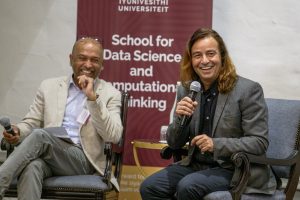
At the centre of the evening were two voices who have earned the right to speak on the intersection of data, health, and impact: Prof Tulio de Oliveira, Director of the Centre for Epidemic Response and Innovation (CERI), and Prof Kanshukan Rajaratnam, Director of the School for Data Science and Computational Thinking at Stellenbosch University.
Their discussion was neither abstract nor detached. They spoke to the urgency of real problems: capacity constraints in health systems, equitable access to innovation, the responsible use of data, and the importance of keeping human beings at the centre of every technological decision.
Prof Rajaratnam was direct about what the moment demands of both academia and industry. “We face grand challenges that no single discipline can solve. Data science and AI touch every domain, which gives data scientists and AI researchers a real opportunity – and a responsibility, to bring together expertise across fields, government, civil society, and industry,” said Prof Rajaratnam. “The task is to co-create contextual solutions to these challenges, and to own the outcome together rather than working on parallel tracks.”
These are not unsolvable challenges. But they require precisely the kind of collaboration the dinner was designed to foster: open exchange built on shared vision and mutual accountability.
The Research Foundation Is Already Here
One of the clearest takeaways from the evening was that South Africa’s AI and data science ecosystem is already producing results that reach well beyond the country’s borders.
CERI’s work in genomic surveillance, epidemic modelling, and open science has established the continent as a serious player in global health research. The expertise exists. The infrastructure is growing. What the next level of impact demands is intentional partnership – research institutions and industry working not in parallel, but in genuine collaboration.
Learning in the Room
Among those present was Puseletso Manyaka-Lesofe, a Medical Scientist and 2026 African STARS MBA HCL Fellow, whose accolades – including the 2025 WIA Young Leaders Laureate and recognition in Forbes Africa’s Over 30 Under 50 – reflect a career already defined by purpose and momentum.
She came to support her professors, she said. “Their conversation was brilliant. Thought-provoking discussions on how data and innovation are reshaping healthcare and research left me deeply inspired.”
What made the evening particularly meaningful was the personal dimension: both professors are directly connected to her MBA studies, conducted in partnership with the Mastercard Foundation. To witness their thinking firsthand – to see the people behind the ideas she engages with daily – was, in her words, both humbling and motivating.
“The aim is not just to absorb knowledge, but to enjoy the journey while engaging with brilliant minds, asking questions, and having fun while growing.” It is a disposition well suited to the moment. The questions being asked at events like this one – about health systems, AI governance, and who ultimately benefits from innovation – require people who are genuinely curious, not merely credentialed.
Why These Rooms Matter
Industry dinners can be easy to dismiss as networking dressed up in formal wear. This one was something different. By bringing researchers, alumni, and industry leaders into the same space, the Alumni Industry Dinner Series creates room for conversations that rarely happen in day-to-day professional life. The value lies not only in the exchange of ideas, but in building lasting relationships between those generating new knowledge and those positioned to apply it.
In health research, the stakes make those connections particularly important. Questions of access, capacity, and responsible innovation are not abstract ethical dilemmas – they are operational realities that determine whether new tools and technologies reach the people who need them most. The dinner in Sandton did not resolve those questions. But it moved them forward, by putting them in the open among people positioned to act.
The Next Table
The Stellenbosch University Alumni Industry Dinner Series continues to showcase the people and ideas driving innovation across the University, while creating opportunities for meaningful engagement beyond campus. For those working at the intersection of data, health, and impact, these are conversations worth having.
The work is already here. What comes next depends on whether we build the partnerships to match.
News date: 2026-07-27
Links: