
From Brazil to Stellenbosch: How One Developer Chose Research and Never Looked Back
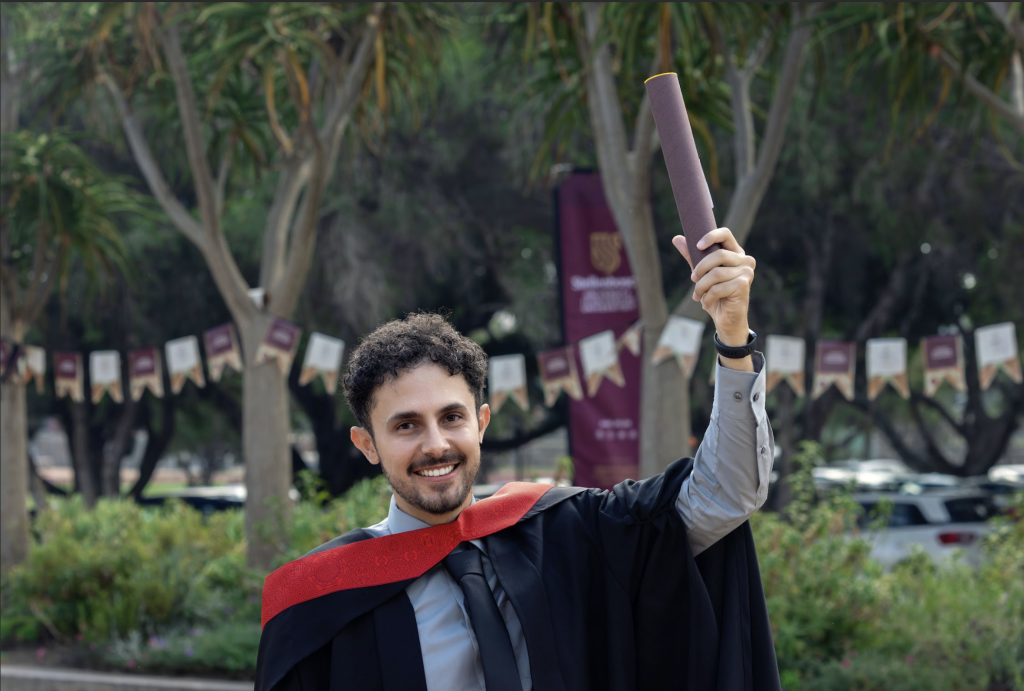
There is a particular kind of courage it takes to leave everything familiar and build something new on the other side of the world. On 24 March, at the Stellenbosch University Faculty of Science graduation ceremony, Danilo De Silva walked across the stage to receive his MSc in Computer Science. For Danilo, that journey started not with ambition, but with an invitation.
Danilo grew up in Governador Valadares, a medium-sized town in the eastern part of Minas Gerais, Brazil, where curiosity about computers, science and the universe came early. That curiosity led him to the Federal University of Itajubá (UNIFEI), where he completed his undergraduate degree and wrote a final project on data storage mechanisms for biological data, his first real taste of research. After graduating, he took what seemed like the practical route, working as a software and database developer in industry. It was a steady path. But it was not the path that would define him.
The turning point came through Dr. Joicy Xavier, who had co-supervised his undergraduate work and extended an invitation that would change the trajectory of his career entirely: come to Stellenbosch University in South Africa and pursue a Master's degree at the Centre for Epidemic Response and Innovation (CERI). The project built directly on Danilo's previous research, this time focused on developing data management systems to address real challenges faced by the INFORM Africa Research Study Group, a network working at the frontlines of epidemic response on the continent.
The work matters. In global health research, data is only as useful as the systems built to manage it. Poor data infrastructure means lost findings, missed patterns and delayed responses to outbreaks. By developing robust software solutions for research applications, Danilo's work sits quietly but critically behind the kind of science that informs public health decisions across Africa.
Under the supervision of Dr. Marcel Dunaiski, with co-supervision from Dr. Monika Moir and Dr. Joicy Xavier, Danilo spent his Master's years not just writing code but contributing to academic publications and shaping his long-term vision as a researcher. His supervisors, he notes, played a role that went beyond technical guidance, helping him grow into the kind of researcher who thinks carefully about the problems worth solving.
That growth did not come without friction. "Coming from a context in Brazil where research careers are often underrepresented and limited by funding and opportunities, pursuing this path was not always straightforward. But my experience at CERI, Stellenbosch University helped me challenge those perceptions and see the transformative potential of research." said Danilo De Silva, MSc Computer Science graduate
Today, Danilo is not heading home to step back from that world. He is staying, committed to pursuing a PhD at Stellenbosch University, deepening his expertise and continuing to contribute to research that addresses pressing challenges in the Global South.
His story is a reminder that the path into research is rarely straight, and that sometimes the most important step is simply saying yes to an opportunity, even when it asks you to cross an ocean.
News date: 2026-03-26
Links: